Iran war: Trump says US will 'finish the job'
Published April 1, 2026last updated April 2, 2026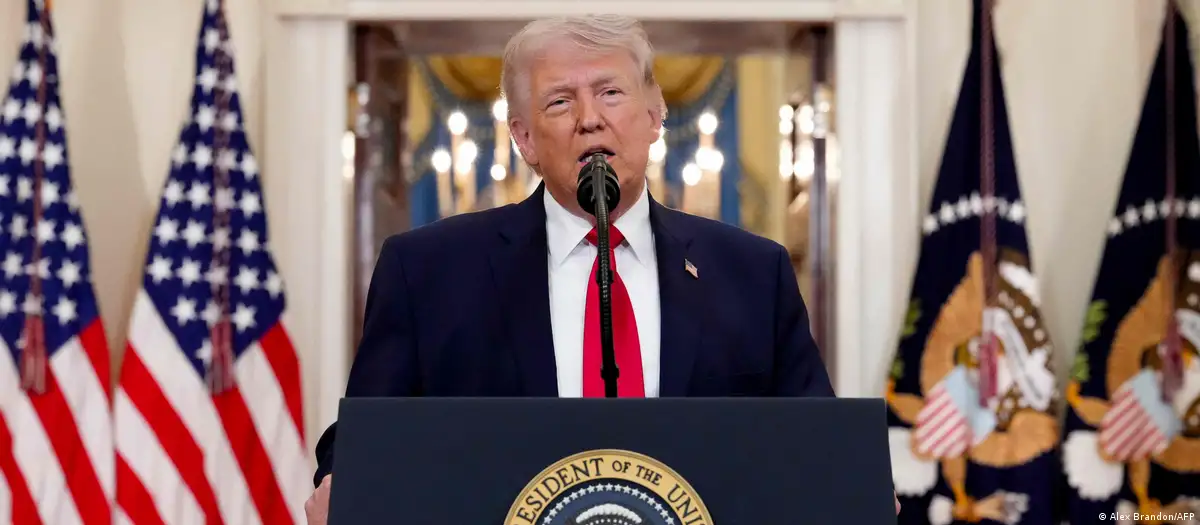
What you need to know
- President Donald Trump says the US's core objectives in Iran war are 'nearing completion'
- Trump also says the US will continue hitting Iran 'extremely hard over the next two to three weeks'
- Trump seeks to allay concerns about rising oil prices, saying the US has plenty of its own fuel thanks to his 'drill, baby, drill' attitude to domestic oil production
- Trump again calls on countries that rely on the Strait of Hormuz to keep the vital shipping lane open
- Iranian President Masoud Pezeshkian says 'the choice between confrontation and engagement is both real and consequential' in an open letter to the American public ahead of Trump's speech
- Tehran again rejects Trump's claim that it asked for ceasefire
This blog has now closed. You call follow Thursday's developments here.
Here is a roundup of the major headlines from the US-Israeli war with Iran on Wednesday, April 1, 2026:
Asian stocks fall, oil rises after Trump speech
Oil rose more than 4% and Asian stocks fell after US President Donald Trump gave an update on the Iran war.
Brent crude, the international standard, jumped 5% to $106.22 (€92) per barrel, while benchmark US crude rose 4.2% to $104.36 a barrel.
Tokyo’s Nikkei 225 was down 1.4% to 53,004.81 in early Asia trading on Thursday. South Korea’s Kospi lost 3.4% to 5,292.36. Hong Kong’s Hang Seng fell 0.8% to 25,082.59.
US stock futures, meanwhile, slid 1% and European futures sank over 1.5%.
Iran to blame for rise in gas prices, Trump says
After claiming military successes in the campaign against Iran, Trump turned to the economic impact of the war.
He said Iran was to blame for a rise in oil prices that he said would be "short-term." The rise is "entirely the result of the Iranian regime launching deranged terror attacks against commercial oil tankers and neighboring countries that have nothing to do with the conflict."
The war has pushed up oil prices, with the average price for a gallon of gasoline in the US having risen to $4, a first since 2022.
Rising fuel prices throughout the conflict have also inflicted hardships elsewhere, for example, in the Philippines, which became the first country to declare a national energy emergency last week.
The European Commission took note of the strain on energy resources as well, telling people a day ago to work from home or fly less, with the EU energy chief calling on member states to double down on renewable energy.
Trump says Iran war 'nearing completion'
Donald Trump repeated his claim that the US was close to wrapping up the war in Iran, adding that Washington's "core strategic objectives" in the war were nearing completion.
"I'm pleased to say that these core strategic objectives are nearing completion," Trump said.
He added that the US would continue to hit targets in the Islamic Republic over the next two to three weeks. "We are going to finish the job, and we're going to finish it very fast. We're getting very close," Trump said.
He then repeated Defense Secretary Pete Hegseth's claim that family members of American soldiers killed in the Iran war had also urged him to "finish the job."
Trump also mentioned the Strait of Hormuz, saying the US imports "almost no oil through the Hormuz Strait and won’t be taking any in the future."
"We don't need it. We haven’t needed it, and we don’t need it. We've beaten and completely decimated Iran," he said.
"And the countries of the world that do receive oil through the Hormuz Straight must take care of that passage. They must cherish it. They must grab it and cherish it."
Trump lays out what he describes US military successes in the Iran war
Donald Trump has begun his update on the Iran war by reiterating what he called US military successes in the Middle East.
Speaking in the Cross Hall at the White House, Trump said that Operation Epic Fury’s actions over the past month meant that Iran's "ability to launch missiles and drones is dramatically curtailed, and their weapons factories and rocket launchers are being blown to pieces."
Trump said that the country's "navy is gone, their air force is in ruins" and the country's leaders "are now dead."
"We’re going to hit them extremely hard over the next two to three weeks; we’re going to bring them back to the stone ages where they belong. In the meantime, discussions are ongoing," he said.
Trump kicks off address to nation by praising Artemis II mission
Trump said he was pleased to see NASA's first crewed mission to the moon in 53 years go so well.
"Let me begin by congratulating the team at NASA and our brave astronauts on the successful launch of Artemis II," Trump said. "It was quite something."
Trump to address the nation on Iran war
President Donald Trump will address the nation Wednesday night and offer an update on the war in Iran.
It will be his first prime-time speech since the US-Israeli joint military offensive against Iran began more than a month ago.
The speech will offer Trump a chance to articulate clear objectives for the war.
It comes amid rising oil prices, volatile financial markets and polling showing rising public discontent over the conflict.
NATO chief to visit US as Trump threatens exit from alliance
NATO Secretary-General Mark Rutte will visit Washington next week to hold talks with US officials, a spokesperson for the military alliance said.
The visit comes amid a growing rift between the Trump administration and other NATO allies.
In recent days, US President Donald Trump has blasted European allies over differences on the Iran war and their rejection of the US leader's call to help open up the Strait of Hormuz.
Trump said he was even considering pulling the US out of the military alliance, which has been the cornerstone of the West's security ever since it was formed in 1949.
Iranian President Pezeshkian writes letter to people of US
Iranian President Masoud Pezeshkian penned an open letter to the people of the US, criticizing what he called an absurd operation that is costly for their nation.
"To the people of the United States of America and those who seek truth and a better life amid distortions and constructed narratives," Pezeshkian wrote at the beginning of his letter.
"The Iranian people harbor no enmity toward other nations, including the people of America, Europe, or neighboring countries," he said.
He also suggested that Israel dragged the US into the war. "Is it not the case that America has entered this aggression as a proxy for Israel, influenced and manipulated by that regime?"
"Is America really first on the list of priorities of the US government?" he asked.
"Today, the world stands at crossroads. Continuing along the path of confrontation is more costly and futile than ever before. The choice between confrontation and engagement is both real and consequential; its outcome will shape the future for generations to come," the Iranian president said at the end of his letter.
"Throughout its millennia of proud history, Iran has outlasted many aggressors. All that remains of them are tarnished names in history, while Iran endures — resilient, dignified, and proud."
He did not mention the US claims of talks, nor did he touch on President Trump's claim that he himself had asked the US for a ceasefire, a claim the Iranian Foreign Ministry has already denied.
IEA, IMF, World Bank 'join forces' to respond to impacts of war
The heads of the International Energy Agency, the International Monetary Fund, and World Bank Group have agreed to form a coordination group to better respond to the economic upheaval caused by the Iran war.
"The Middle East war has caused major disruptions to lives and livelihoods in the region and triggered one of the largest supply shortages in global energy market history," they said in a statement, adding that low-income countries were disproportionately affected.
The impact, they said, is "already transmitted through higher oil, gas and fertilizers prices, and is triggering concerns about food prices as well."
"At these times of high uncertainty, it is paramount that our institutions join forces to monitor developments, align analysis, and coordinate support to policymakers to navigate this crisis," the statement said.
The coordination group will, for example, assess economic impacts and supply chain disruptions across countries, gauge different financing needs, and mobilize relevant stakeholders to provide support, among other things, the statement said.
Huge crowds attend funeral of IRGC navy chief Tangsiri in Tehran
Iran's capital, Tehran, held a funeral on Wednesday for Islamic Revolutionary Guard Corps (IRGC) commander Alireza Tangsiri who was killed in an Israeli airstrike last week.
State television broadcast live footage showing crowds of mourners waving Iranian flags and holding posters of his image.
Israel announced last Thursday it had killed Tangsiri, head of the Revolutionary Guard's navy, in a "precise and lethal operation," along with senior naval command officials.
Tehran confirmed his death on Monday.
A funeral was also held for Tangsiri on Tuesday in Bandar Abbas, a key port city on the Strait of Hormuz.
UK-hosted meeting on reopening Hormuz to take place Thursday
A virtual meeting of some 35 countries to discuss options for reopening the Strait of Hormuz is expected to take place on Thursday.
The strategic waterway has been closed to almost all ship traffic since the start of the Iran war, sending fuel prices soaring.
UK Prime Minister Keir Starmer announced the meeting earlier Wednesday. He said it would be hosted by Foreign Secretary Yvette Cooper and aim to assess possible measures to allow shipping to resume after the end of the war.
"Following that meeting, we will also convene our military planners to look at how we can marshal our capabilities and make the strait accessible and safe after the fighting has stopped," Starmer said.
The meeting will be attended by countries who recently signed a statement saying they were prepared to contribute to efforts to secure safe passage through the strait, including Germany, France and Japan.
Iran fires volley of missiles at Israel ahead of Passover
Air raid sirens sounded in Tel Aviv on Wednesday evening as Iran fired a barrage of missiles shortly before the start of the Jewish festival of Passover.
There were no immediate reports of casualties.
Israeli media reported that around 10 ballistic missiles had been fired at central Israel — one of the largest such attacks since the early days of the war.
Israel's fire and rescue service said there had been multiple "impacts" in the greater Tel Aviv area, but it was not clear if they were caused by strikes or by debris from intercepted missiles.
Meanwhile, Israel's military said its Air Force was carrying out strikes on dozens of targets across the Iranian capital, Tehran.
The evening attack followed a round of strikes earlier on Wednesday in the city of Bnei Brak, east of Tel Aviv, that wounded 14 people, including an 11-year-old girl in critical condition, according to the Magen David Adom emergency service. Two others — a 13-year-old boy and a 36-year-old woman — were in mild condition with shrapnel injuries, it said.
Israeli media reported that cluster munitions, which scatter bomblets across a wide area, were used in the attack. Iran and Israel have previously accused each other of using the weapons.
Elsewhere, a 61-year-old man was injured in northern Israel following fire from across the Lebanese border, where Israeli forces are battling Iran-backed Hezbollah.
WATCH — Trump renews NATO attacks as Europe rejects role in Iran war
US President Donald Trump is again threatening to pull out of NATO, calling European allies "cowards" for their refusal to support the joint US-Israeli war against Iran.
But a 2023 law passed by the Biden administration may prove a stumbling block.
Watch DW's report below:
Ryanair CEO says war could disrupt jet fuel supply by June
Jet fuel deliveries to Europe could start to face disruptions at the start of Europe's summer if the US-Israel war with Iran continues, Ryanair chief Michael O'Leary said.
"If this [conflict] continues through to the end of April, we're looking at a risk to supplies in early June. If it runs into May, then we don't know what goes on," O'Leary told a news conference.
If prolonged fighting puts 10% or 20% of the fuel supply at risk in June, July or August, then Ryanair and other airlines "will have to start looking at canceling some flights or taking some capacity out," he added.
The International Air Transport Association (IATA) has warned that Europe is one of the most exposed markets when it comes to potential jet fuel shortages due to the war, with an estimated 25-30% of the region's demand coming from the Persian Gulf.
Iran has effectively closed the Strait of Hormuz, a key oil and gas chokepoint, pushing up energy prices and sparking supply concerns.
O'Leary said Ryanair had not yet seen much of a knock-on impact on its airfares as a result of the conflict, but that ticket prices were still expected to rise by 3 to 4% year-on-year from April to June.
Tehran rejects Trump's claim that it asked for ceasefire
Iran's Foreign Ministry spokesperson, Esmail Baghaei, says US President Donald Trump's comments about Tehran asking for a ceasefire are "false and baseless," Iranian state TV reported.
Trump claimed in a post to his Truth Social platform earlier on Wednesday that "Iran's New Regime President" had made the request.
It was not clear to whom the US president was referring, given Iran still has the same president as it did before the war.
Trump said a ceasefire would only be considered "when Hormuz Strait is open, free, and clear. Until then, we are blasting Iran into oblivion."
The statement came ahead of a primetime presidential address due on Wednesday evening.
Separately, Iran's Revolutionary Guard issued a statement saying the Strait of Hormuz "is firmly and decisively under the control" of its forces.
"This strait will not be opened to the enemies of this nation through the ridiculous spectacle by the president of the United States," it added.