Germany news: Strike to block all flights at Berlin airport
Published March 16, 2026last updated March 16, 2026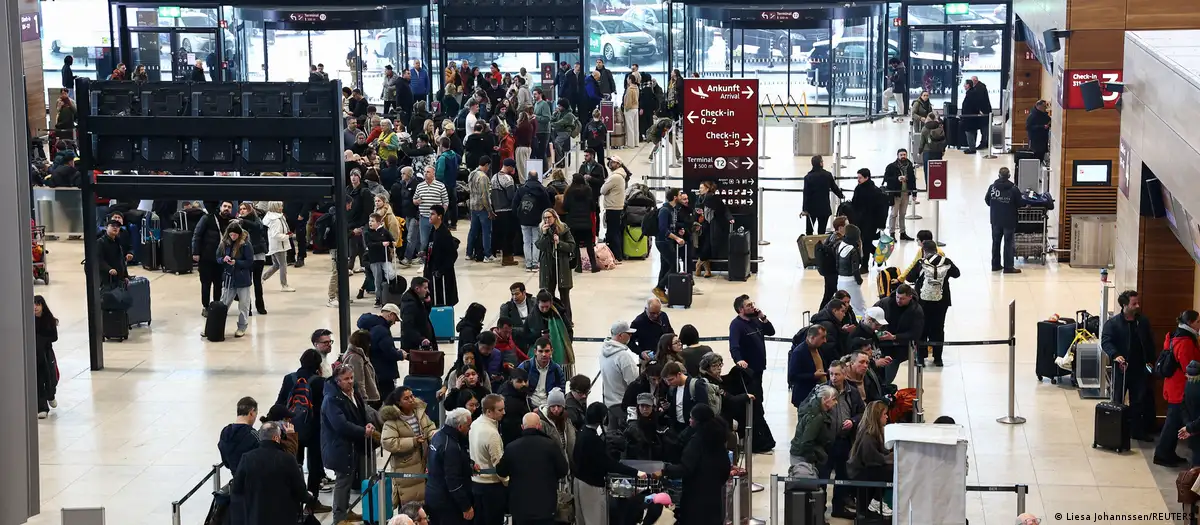
What you need to know
- Berlin airport will close for passengers amid a strike on Wednesday
- Public transport strikes have been called for various parts of Germany this week
- Germany's two ruling parties, the center-right CDU and center-left SPD, look like they are remaining the strongest forces after municipal elections in Hesse
- The far-right AfD made lower than expected gains to take third place, partial results show
- German government figures have expressed disinterest in joining Trump's call to send naval forces to open the Strait of Hormuz
This blog providing a roundup of the top news and human interest stories from and about Germany on Monday, March 16, 2026 is now closed. Thank you for reading.
Berlin-Brandenburg Airport to suspend all flights after strike call
Berlin-Brandenburg Airport, which serves Germany's capital and the surrounding region, will cancel all flights and traffic on Wednesday after the Verdi union announced a strike for that day.
"Please contact your airline or tour operator for information on rebooking and alternative travel options," the airport posted on X.
Verdi called the strike amid a pay dispute with public-sector employers.
"In the second round of negotiations, the employers put forward an offer that [Verdi's] bargaining committee rejected as unacceptable," Verdi said.
Germany and Poland to introduce more frequent and faster train connections
In a bid to reduce travel times on major rail routes between Germany and Poland, German Transport Minister Patrick Schnieder and Polish Infrastructure Minister Dariusz Klimczak signed an agreement in Warsaw.
The deal aims to increase passenger and freight connections and shorten travel times on key routes, including:
- Warsaw–Berlin
- Krakow–Wroclaw–Zielona Gora–Berlin
- Gdansk–Szczecin–Berlin
- Przemysl–Krakow–Wroclaw–Leipzig.
Currently, the journey time by train from Leipzig to Krakow is 7 hours and 30 minutes, covering a distance of 551 kilometres.
In addition, the potential of the planned high-speed projects is to be analysed. The corridors under consideration are:
- Warsaw–Poznan–Berlin
- Warsaw–Wroclaw–Leipzig–Frankfurt am Main
- Warsaw–Wroclaw–Prague–Munich.
"We want to make rail the backbone of our shared economic region and, in doing so, strengthen Europe’s defence capabilities as well," Schnieder said.
According to Klimczak, around 1.2 million people travelled by rail between Poland and Germany last year.
Brandenburg's commissioner for antisemitism resigns from Left Party
Andreas Büttner, the commissioner for antisemitism in the eastern state of Brandenburg, has resigned from the Left Party over what he said were irreconcilable differences.
"It's no longer tenable. I can't go on," Büttner wrote in a statement obtained by the German news agency DPA. "I can no longer remain a member of this party without betraying my own convictions."
The reasons for his decision, as cited by Büttner, are the Left Party's stance on antisemitism, the expulsion proceedings, and personal attacks from within the party.
Büttner pointed out that the Left Party rejects the International Holocaust Remembrance Allianceäs (IHRA) definition of antisemitism because the party views it as a repressive tool against protest.
The party instead adopts the so-called Jerusalem Declaration, which leaves more room for criticism of Israel. In Büttneräs view, it "relativizes antisemitic narratives on key points."
Party leader Jan van Aken expressed regret over Büttner’s decision, but emphasized that the Left takes a clear and unequivocal stand against antisemitism.
The party has been wracked by internal disputes over its stance on Israel, with many of its members being outspokenly pro-Palestinian.
Büttner had been a member of the socialist Left Party since 2015. Prior to that, he had also been a member of the center-right CDU and the pro-business FDP at various times.
CDU politician denies cooperating with AfD in European Parliament
In response to reports of collaboration between the European People's Party (EPP) and far-right factions in the European Parliament, Jens Spahn, leader of the Union (CDU/CSU) parliamentary group, rejected allegations of working with the far-right Alternative for Germany (AfD).
An investigation by the German news agency DPA revealed that the EPP group, which includes the CDU and CSU, recently collaborated with far-right groups in a chat group and at a face-to-face meeting to develop a legislative proposal that would tighten immigration policy. One of these groups is the ENF (Europe of Nations and Freedom), which includes the AfD.
"Such a chat group is not a form of cooperation," said the CDU politician on German channel ntv. "The key point is: No one cares what the AfD wants or does in the Brussels Parliament. Nor is it relevant," he added.
Meanwhile, Markus Söder, the leader of the CSU and Bavarian premier, said that the revelations about a chat group and face-to-face meetings between lawmakers had "greatly surprised, irritated, and disturbed" his party.
However, Söder added that Manfred Weber, the leader of the EPP, had assured him that nothing like this would happen again. "From our perspective, that settles the matter for now and is acceptable," the Bavarian premier said.
German Foreign Minister Johann Wadephul also called on European lawmakers to refrain from cooperating with the AfD. A member of the CDU, Wadephul said any sign of collaboration with the AfD must be avoided.
He urged members of the European Parliament to uphold a "firewall" against the party — a strategy used by Germany's mainstream parties to prevent the far-right group from gaining power.
SPD and CDU to form coalition government in eastern Brandenburg state
The Social Democrats (SPD) and the conservative Christian Democrats (CDU) signed a coalition deal in the eastern state of Brandenburg. This paves the way for a new regional government following the collapse of the previous coalition, which included the SPD and the populist BSW party.
The coalition agreement, which was signed by Premier Dietmar Woidke of the SPD and Jan Redmann, the regional chairman of the Christian Democrats, outlines the government's priorities for the next three and a half years.
The previous SPD-led coalition in Brandenburg, the state surrounding Berlin, fell apart in early January. This occurred less than a year after the coalition took office due to internal disputes within the BSW party.
Rather than calling for early elections, Woidke formed an alliance with the conservative CDU, mirroring the coalition that governs Germany at the federal level.
Church membership falls by more than a million in Germany in 2025
The two main Christian churches in Germany, the Catholic Church and the Protestant Church (EKD), each lost around 3% of their members in 2025, with membership falling by more than a million people in total.
How many members has the Protestant Church in Germany?
- The Protestant Church lost 580,000 members
- Some 350,000 of those withdrew their membership, which is a slight increase from 2024 (345,000)
- 17.4 million people in Germany remain officially Protestant (21% of population), compared to 18.6 million in 2023
-
The number of baptisms remained stable at approximately 105,000, similar to the previous year.
How many members has the Catholic Church in Germany?
- The Catholic Church lost some 550,000 members
- Approximately 307,000 of those withdrew their membership, fewer than in 2024 (321,659)
- The number of Catholics in Germany is down to 19.2 million (23% of the population), compared with some 20.4 million in 2023
- The number of baptisms declined by more than 7,000, dropping to 109,000
- The number of church weddings declined to around 19,500, which was 3,000 lower than the previous year
It is the second year in a row that there have been more departures from the Protestant Church. Between 2019 and 2023, it was the Catholic Church that was seeing higher number of members leaving.
Altogether, some 44% of people in Germany now belong to one of the two main Christian denominations.
The number of Catholics and Protestants officially belonging to their churches in Germany fell below 50% for the first time in 2021.
Strikes to hit public transport, Berlin airport and Eurowings
The Verdi union has called for warning strikes in public transit in several German states. The union announced that buses and trams will remain in the depots all day Thursday in Bavaria, North Rhine-Westphalia, and Hamburg.
This morning, it was reported that strikes would also take place in Saarland and Brandenburg. However, the regional branches of the union have since stated that this is still unclear.
In North Rhine-Westphalia, warning strikes on public transportation will also be held in most regions as early as Tuesday, in addition to Thursday.
A decision on whether companies in Hesse will join the strike is expected as early as Monday following negotiations. In Bremen, according to Verdi, the decision is expected on Wednesday.
Travelers should also expect significant disruptions at Berlin's BER Airport on Wednesday. On Monday, the Verdi union called on airport workers to join a full-day warning strike after receiving an offer from the employers that the union said was "unacceptable."
Meanwhile, pilot strikes are also looming at Lufthansa subsidiary Eurowings. According to the Vereinigung Cockpit union, 94% of participating members voted in favor of industrial action in a strike vote. No specific date for the strike was initially announced.
Iran war not NATO's affair — German government
The war in Iran does not concern the Western military alliance NATO, and Germany will not participate in using military means to secure the Strait of Hormuz for commercial shipping amid the conflict, a German government spokesman said on Monday.
"This war has nothing to do with NATO. This is not NATO's war," Stefan Kornelius said, saying the alliance was there to defend its members' territories and that there was no mandate for its deployment in the present case.
"As long as this war continues, there will be no participation, not even in any effort to keep the Strait of Hormuz open by military means," he said.
His comments echoed those of Foreign Minister Johann Wadephul in Brussels on Monday.
"I don't see that NATO has made any decision in this direction or could assume responsibility for the Strait of Hormuz. If that were the case, then the NATO bodies would address it accordingly," said Wadephul ahead of a meeting of the EU Foreign Affairs Council.
US President Donald Trump has been putting pressure on European allies to help protect the strait, an important oil transport route, warning that otherwise, NATO faces a "very bad" future.
Shipping in the waterway has come to a virtual standstill amid the danger of Iranian attacks in response to the US-Israeli offensive against the Islamic Republic.
Wide consensus in Germany against Strait of Hormuz intervention
Comments by various foreign policy of officials in Germany in the past few days indicate that there is opposition across the political spectrum to deploying European warships to the Strait of Hormuz to protect commercial shipping, as US President Donald Trump has demanded.
The foreign policy spokesman for Chancellor Friedrich Merz's conservative CDU/CSU bloc told the broadcaster Deutschlandfunk on Monday that navy units would not be enough to secure the strait against attacks by Iran.
He said Iran could easily carry out mortar or drone attacks from the densely populated coastline of the waterway between Iran and Oman.
German Foreign Minister Johann Wadephul also rejected Germany's military involvement in the strait on Sunday.
The center-left Social Democrats' (SPD) foreign policy expert, Adis Ahmetovic, said that while the German navy was very capable, it was currently not geared toward participation in such a situation.
A co-leader of the far-right Alternative for Germany (AfD) party, Alice Weidel, has also told the news portal The Pioneer that any deployment of the "small German navy ... would be illusory and highly dangerous."
Shipping through the Strait of Hormuz, a waterway that serves as a transport route for around a fifth of the global oil supply, has been virtually stopped by Iran in response to an assault by the US and Israel.
'A giant of philosophy' — UN chief Guterres on Jürgen Habermas
UN Secretary General Antonio Guterres has expressed his deep sorrow at the death of German philosopher and sociologist Jürgen Habermas, who died on Saturday aged 96.
"No philosopher influenced my own thinking throughout my life in politics as much as Jürgen Habermas," Guterres said in a statement released by his press office on Sunday.
Guterres described Habermas as "a giant of philosophy and true public intellectual."
"[Habermas'] contributions across political-legal thought, sociology, communication studies, argumentation theory, language and rhetoric, informed and shaped our understanding of the nature and value of democratic societies," Guterres said.
Guterress said that Habermas' definition of democracy as, among other things, "the permanent interflow of communication between political decision makers and civil societies," was particularly pertinent to the present time.
"Today more than ever, we need this constant interaction — this two-way street between politics and people — to better understand the challenges we face, and to forge effective solutions," Guterres said.
Russia's trial of Putin-critical German sculptor hears closing arguments
An in absentia trial at a Moscow court of German sculptor Jacques Tilly, who is charged with mocking Russian President Vladimir Putin in satirical Carnival floats, was to hear closing arguments on Monday.
A verdict and sentence could also be handed down.
Tilly has been charged under Russian libel laws and laws forbidding "propaganda of non-traditional sexual relations."
Other charges relate to respect for religious sensitivities and reports on the actions of the Russian military in Ukraine that are deemed as false by authorities.
Tilly has dedicated several floats to Putin that were used in Carnival parades in Düsseldorf, where he lives.
One from 2024 depicted Putin and Russian Orthodox Patriarch Kirill having oral sex, while another showed Putin in a bath of Ukrainian blood, a reference to Russia's invasion of that country.
In the case of a guilty verdict, Tilly would not be deported to Russia by Germany and thus not face imprisonment there, but his future travel could be limited to countries that don't have extradition agreements with Moscow.
Rail operator DB pays out less compensation for delays in 2025
Germany's national rail operator Deutsche Bahn (DB) paid out more than €156 million ($178.5 million) in compensation to passengers — or would-be passengers — for delays and cancelations in 2025, well down on payment of almost €197 million the previous years.
A DB representative said the smaller sum likely resulted partly from there having been fewer exceptional situations such as strikes in 2024.
"But it is still a big financial burden for us," said Michael Peterson, who is in charge of long-distance services.
DB said that there were some 6.2 million claims for compensation in 2025, three times the number in 2019, when €52.6 million was paid out in compensation.
For long-distance trains, the punctuality rate in February was 59.4%, meaning that stations along the respective route were reached with a delay of at least 6 minutes in around 40% of cases.
Just 65.3% of long-distance passengers reached their end destination with less than 15 minutes' delay.
DB pays a 25% refund on one-way tickets in cases of delays over 60 minutes and 50% when a train is more than 120 minutes late.
Germany's railway network is currently undergoing considerable refurbishment after decades of relative neglect.
However, the conservative-led coalition government under Chancellor Friedrich Merz has reportedly walked back several promises in this regard.
Italian bank UniCredit makes takeover bid for Germany's Commerzbank
Italian bank UniCredit says has submitted an official takeover bid of €35 billion ($40 billion) for German lender Commerzbank.
It said the offer aims to surpass the 30% threshold stipulated in German takeover law but that it did not expect to gain full control
UniCredit is already the largest shareholder in Commerzbank.
The move is likely to be met with fierce resistance by Commerzbank's management, employee representatives and the German government.
Germany's ruling coalition to face several election tests in 2026
The first of five state elections this year has already taken place in Baden-Württemberg, where Chancellor Merz's CDU lost out narrowly to the Greens.
But there are still four to go, with the far-right Alternative for Germany (AfD) party under particular scrutiny as its popularity grows across the country, particularly in the eastern states that formed part of former communist East Germany.
Here is a rundown of the votes still to come in Germany's Super Election Year, with all dates still provisional:
Rhineland-Palatinate (March 22):
The western state of Rhineland-Palatinate is currently governed by a "traffic light" coalition of center-left Social Democrats (SPD, signature color red), pro-business Free Democrats (FDP, signature color yellow) and environmentalist Greens.
Its premier since 2024 has been Alexander Schweitzer, the former state labor minister, who took over from his party colleague Malu Dreyer after she stepped down for health reasons.
At the 2021 elections, the SPD won 35.7%, the CDU 27.7%, the Greens 9.3%, the AfD 8.3% and the FDP 5.5%.
Recent polls have, however, shown a different picture, with the CDU having a narrow lead over the SPD, while the AfD has more than doubled its voter support. The FDP has sunk beneath the 5% hurdle needed for parliamentary representation in the surveys.
Saxony-Anhalt (September 6):
The eastern state of Saxony-Anhalt is governed by a coalition of the CDU, SPD und FDP under CDU Premier Sven Schulze, who took over from his party colleague Reiner Haseloff in January of this year.
In 2021, the CDU was the strongest party, winning 37.1% of the vote, ahead of the AfD on 20.8%. The SPD received 8.4% behind the Left Party on 11%. The FDP received 6.4%, the Greens 5.9%.
A January poll from Insa showed a different picture, with the AfD well in the lead on 39%, followed by the CDU on 26%. The Left Party had 11%, the SPD 8%, the leftist BSW 6%, while the Greens and FDP were both below the 5% hurdle.
Berlin (September 20):
The city-state of Berlin has been governed since 2023 by what is traditionally dubbed a "grand coalition" of the CDU and SPD under its governing mayor, Kai Wegener, who holds the same rank as other state premiers.
In a repeat election held in 2023 after a 2021 was declared invalid, the CDU received 28% of votes, the SPD and Greens 18.4%, the Left Party 12.2 and the AfD %9.1. The FDP again slipped below the 5% hurdle.
A February poll by the Insa institute showed that the AfD has grown in popularity and would receive around 17% of the vote if elections were held now, making it the second-strongest party behind the CDU on 22%.
The SPD was polling at 16%, followed by the Greens and Left Party on 15%.
Mecklenburg-Vorpommern (September 20):
The eastern state of Mecklenburg-Vorpommern, sometimes called Mecklenburg-Western Pomerania in English, is currently governed by a leftist coalition of the SPD and the socialist Left Party under SPD premier Manuela Schwesig.
At 2021, the SPD received 39.6% of the vote, the AfD 16.9%, the CDU 13.3%, the Left Party 9.9%, the Greens 6.3% and the FDP 5.8%.
A recent survey from Forsa shows that the AfD has experienced a huge surge in popularity, with 37% support.
The SPD was on 23%, the CDU on 13%, the Left Party on 13%, the BSW on11% and Greens on 5%. Again, the FDP was below the 5% hurdle.
While you're here: Every Tuesday, DW editors round up what is happening in German politics and society. You can sign up here for the weekly email newsletter, Berlin Briefing.
CDU leads the pack in Hesse regional elections — partial results
Partial results from Sunday's regional elections in Germany's central state of Hesse show that the Christian Democrats (CDU) are set to remain the strongest power, receiving 29.7% of the vote, with their coalition partners at national level, the Social Democrats (SPD), coming in second place with 20.2%.
This compares with 28.5% and 24% respectively at 2021 elections.
The result is likely to come as somewhat of a relief to Chancellor Friedrich Merz of the CDU, whose party was narrowly defeated by the Greens in state elections in neighboring Baden-Württemberg a week ago.
In the Hesse elections, the Greens did not fare as well, losing their position as third-strongest party at local level to the anti-immigrant Alternative for Germany (AfD), with the partial results released by the state statistical office in Wiesbaden giving the environmentalist party 14.4% compared with 15.9% for the far-right one.
The AfD's result more than doubled that from the last regional elections in the state five years ago, when it received 6.9%.
The party's surge to popularity across the country is being watched with concern by many observers who see the AfD as a danger to democracy.
The AfD's regional chapter in Hesse has been labelled a suspected extremist organization by the domestic intelligence in the state, while the national AfD was classified as a confirmed right-wing extremist group last year for alleged racist and anti-democratic tendencies.
The party is contesting the label in court.
Sunday's vote will decide the make-up of local councils and city parliaments in Hesse, along with several mayoral posts.
Hesse is home to Germany's financial hub of Frankfurt.
Altogether 4.7 million people were eligible to vote, including some 430,00 non-German citizens from other European Union member states. Voter turnout was 54.4%, beating 50.4% in 2021.